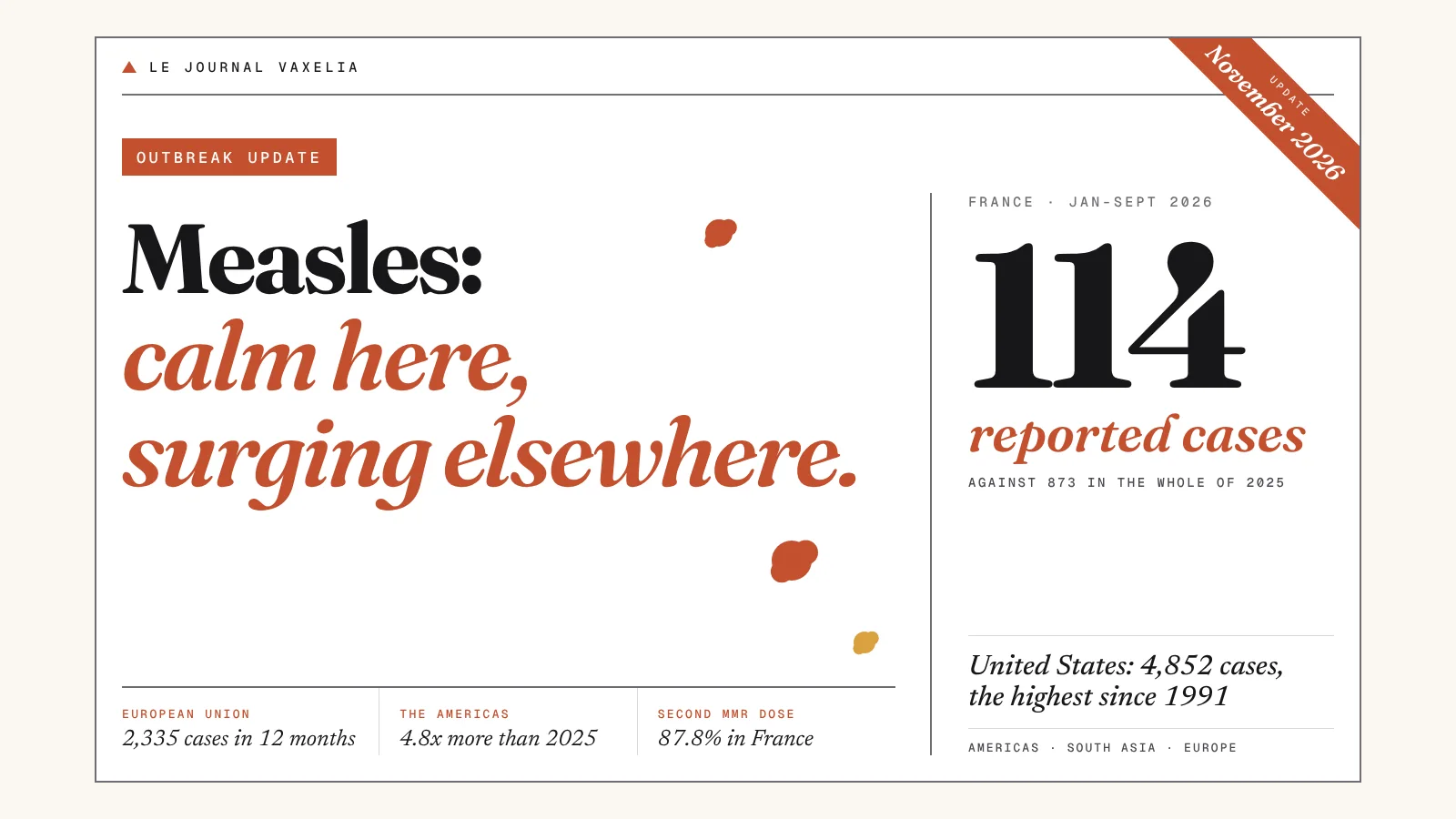
| Area | Situation in 2026 | Key figure | Trend |
|---|---|---|---|
| France | Low-level circulation | 114 cases (Jan-Sept) | Sharply down |
| European Union / EEA | Receding after the 2024 peak | 2,335 cases over 12 months, no deaths | Down |
| United States | Highest since 1991 | 4,852 cases as of 29 October | Up |
| The Americas | Elimination status lost in November 2025 | 55,792 cases, 77 deaths (weeks 1-39) | 4.8x the 2025 level |
| World | Above the 2019 level | 11 million infections in 2024 | Vaccine coverage stalled |
France: the 2023-2025 wave has subsided
Since September 2025, measles has only been circulating at a low level in France. Just 2 new cases were reported in September 2026, and no cluster of 5 or more cases was active at the end of the month (Santé publique France, 15 October 2026).
The previous wave was serious, though. In 2025, France recorded 873 cases, 128 of them imported, and 7 deaths linked to the disease: 4 immunocompromised adults and 3 children who died of a late complication (2025 annual report).
Reported measles cases in France
Per year, 2018-2026
The 114 cases of 2026 are far from mild:
| Indicator (as of 30 September 2026) | Value |
|---|---|
| Hospitalisations | 41 (36%), 2 of them in intensive care |
| Complications | 17 (15%), 8 of them pneumonia |
| Deaths | 0 |
| Median age | 20.5 years |
| Cases not up to date with vaccination (known status) | 42 of 77 (55%) |
| Départements affected | 34, led by Yvelines (10%), Hauts-de-Seine (9%) and Moselle (8%) |
More than one patient in three was hospitalised. The median age is 20.5, but cases are not limited to young adults: people aged 40 and over are the most affected age group (16%), ahead of 1-4-year-olds and 20-24-year-olds (14% each). Among the 77 cases targeted by vaccination with known status, 55% were not up to date and 45% had received two doses.
The weak spot: the second dose
The first dose of the MMR vaccine (measles, mumps, rubella) has finally reached the target: 95.2% of children had received it by 21 months. The second dose, essential for lasting protection, stalls at 87.8% at 33 months, below the 95% target in every region (Santé publique France, April 2026).
| MMR coverage (data as of 31/12/2025) | Rate | 95% target |
|---|---|---|
| 1 dose at 21 months (children born in 2024) | 95.2% | Met |
| 2 doses at 33 months (children born in 2023) | 87.8% | Not met |
| 2 doses in Martinique | 78.9% | Not met |
| 2 doses in Guadeloupe | 78.6% | Not met |
Santé publique France notes that these figures may be underestimated, because free vaccines given in mother and child health centres (PMI) are poorly recorded. The gap is still too wide to be a mere artefact.
Teenagers and young adults are affected too. Santé publique France estimates that around 400,000 young people aged 13 to 21 may be unprotected: they received their first dose before 12 months of age and never had a third one. On top of that, 1.5 million adults aged 18 to 35 are insufficiently protected.
Europe: a clear decline after the 2024 peak
The European Union and European Economic Area reported 2,335 cases between September 2025 and August 2026, with no deaths (ECDC, 29 September 2026). Western Europe counted 35,233 cases in 2024, then 7,661 in 2025.
Five countries account for almost 80% of cases: Italy (653), Bulgaria (564), Romania (255), Spain (230) and France (146 over this period). Relative to population, Bulgaria is by far the worst hit, with 87.6 cases per million inhabitants against an average of 5.1.
Among European cases over the period:
- 71.9% were unvaccinated (among cases with known status);
- 27.2% were under 5;
- 17% were imported or linked to an imported case.
Only 4 countries out of 30 reached 95% two-dose coverage in 2024: Cyprus, Hungary, Iceland and Portugal. The ECDC calls for catch-up vaccination of teenagers and young adults, and for checking your vaccination status before any trip.
United States and the Americas: the 2026 epicentre
The United States had 4,852 confirmed cases as of 29 October 2026, more than double 2025 (2,289 cases) and the highest since 1991 (CDC). 96% of patients were unvaccinated or had unknown status. MMR coverage among children entering kindergarten has fallen to 92.4%, from 95.2% in 2019-2020.
| United States | 2026 (as of 29 October) | 2025 (full year) |
|---|---|---|
| Confirmed cases | 4,852 | 2,289 |
| Hospitalisations | 511 (about 11%) | 243 (11%) |
| Deaths (CDC) | 3, under review | 3 |
Across the continent, the Pan American Health Organization counts 55,792 cases and 77 deaths over the first 39 weeks of 2026, in 17 countries or territories. That is 4.8 times more than over the same period of 2025 (PAHO, via Global Risk Atlas). Guatemala, Mexico and the United States have recorded the most deaths.
Canada lost its measles elimination status on 10 November 2025, which cost the whole region that status (CIDRAP). The status of the United States is due to be reviewed in November 2026 (U.S. News).
Worldwide: more cases than before Covid
The WHO estimates there were 11 million measles infections in 2024, about 800,000 more than in 2019, and 95,000 deaths, mostly among children under 5 (WHO, November 2025). Mortality has fallen by 88% since 2000, but vaccine coverage is no longer improving: 84% for the first dose and 77% for the second in 2025, far from the 95% needed (UNICEF/WHO, July 2026).
Between 2019 and 2024, cases rose by 86% in the Eastern Mediterranean, 47% in Europe and 42% in South-East Asia. Africa is the exception, with 40% fewer cases and half as many deaths. In 2025, 57 countries had a major outbreak, and 96 countries had eliminated the disease.
The five largest outbreaks worldwide
Cases reported to the WHO, December 2025 to May 2026
South Asia now carries the largest outbreaks. In Bangladesh, more than 120,000 suspected cases and almost 800 deaths, mostly children, had been recorded by the end of July 2026 (WHO, April 2026; PMC).
Why France's respite is fragile
Measles typically picks up again in winter and spring. A resurgence in France in early 2027 is therefore possible.
The risk comes first from abroad. France recorded 128 imported cases in 2025, mostly from Morocco, and the ongoing outbreaks in the Americas and South Asia will not reduce those arrivals. It also comes from within: more than 1.9 million people aged 13 to 35 are not fully protected.
Finally, the WHO is concerned about budget cuts to surveillance and vaccination programmes, which risk widening these gaps.
What you can do
Open your health record, and your children's
Anyone born since 1980 should have received two doses of measles vaccine. Lost your record? Here is how to rebuild it.
If a dose is missing, catch up, even as an adult
Your GP, pharmacist or midwife can give it. This live vaccine is contraindicated during pregnancy and for some immunocompromised people.
Before a trip to the Americas or South Asia, check the whole family
Ongoing outbreaks make exposure more likely than in Europe. Our travel vaccination guide.
What to watch next: the decision on measles elimination status in the United States, expected in November 2026.
Frequently asked questions
Two doses, and the proof at hand
Vaxelia keeps a vaccination record for each family member and applies France's 2026 vaccination schedule: you see at a glance whether the second MMR dose is missing, and you get a reminder to catch up. Your data stays on your phone.
Download Vaxelia — FreeSources: Santé publique France, measles as of 30/09/2026 (15 October 2026) · Santé publique France, 2025 annual measles report (18 May 2026) · Santé publique France, childhood vaccination, 2025 data (27 April 2026) · ECDC, Measles and Rubella monthly report (29 September 2026) · CDC, Measles Cases and Outbreaks (30 October 2026) · Contagion Live, Measles Update (30 October 2026) · Global Risk Atlas, PAHO Americas report (14 October 2026) · PAHO, 2026 multi-country outbreak · CIDRAP, Canada loses elimination status · U.S. News, tracking 2026 measles outbreaks · WHO, Measles deaths down 88% since 2000 (28 November 2025) · UNICEF/WHO, WUENIC 2025 (July 2026) · WHO, Disease Outbreak News, Bangladesh (April 2026) · PMC, Measles outbreaks surging globally in 2026. This article is for information only and is not medical advice. For any vaccination decision, talk to your GP or pharmacist.